Design
When people ask me the standard question: what do you do? It’s hard to give a straight answer. I do strategy, research, design, writing… where do I start? I studied and practiced graphic design for a time in my life, among other things. Design is integral to what I do, but I am a not a designer. When I talk about design, mostly I don’t talk about a craft or a style.
A Designer is a planner with an aesthetic sense.
Thus Bruno Munari1 elegantly captured the essence of what designers do. Designers plan for a future state.
The word “design” doesn’t have a direct equivalent in Italian. Disegnare means “to draw.” Before adopting the now ubiquitous English term, we used the verb progettare, which means to design: to imagine and plan something into existence.
Progettare (pro·get·tà·re), v.tr. (progètto, ecc.):
- Ideare una costruzione, un’opera, ecc., eseguendo i disegni, i calcoli, gli studi necessari alla sua realizzazione.
This definition underlines the multidisciplinary nature of design. Ideare (to ideate) is to imagine, conceive, and generate ideas. To draw, to calculate… in a word, design. Interestingly the etymology of progettare, to project comes from latin: projectare = ‘to throw forward’. In other words, to envision.
The Swedish word for designer is Formgivare, or “form-giver.”
I’m thinking about design in general terms rather than in a specific medium or application. Dieter Rams 10 principles of Good Design were developed in a product design context, but they are equally applicable to graphic design, architecture, and many other areas.
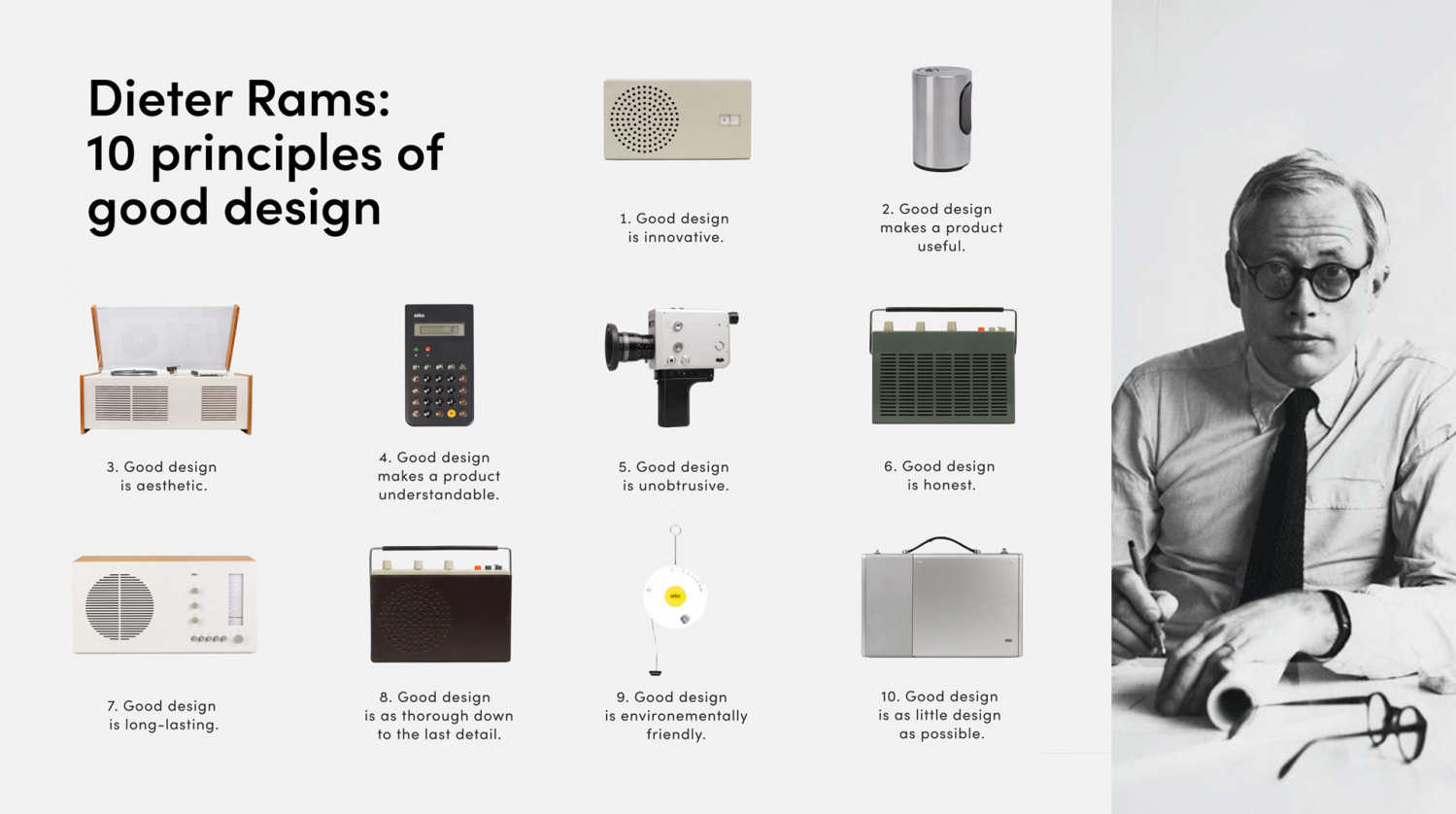 Ten principles of good design by D.Rams - Photo: Abisag Tüllmann, Source: Vitsœ
The 6th principle is about truth:
“Good design is honest. It does not make a product more innovative, powerful or valuable than it really is. It does not attempt to manipulate the consumer with promises that cannot be kept.”
The 10th principle sums up Rams’ overall design ethos:
“Good design is as little design as possible. Less, but better — because it concentrates on the essential aspects, and the products are not burdened with non-essentials.”
I fully subscribe to less but better. I am also aware that it represents a modernist perspective. “Less is more,” as Mies van der Rohe famously said. Excellent principle when we aim for clarity and simplicity, focusing attention to what is essential.
On the other hand the postmodern critique, articulated by Robert Venturi, countered that “less is a bore.” Venturi advocated for embracing diversity, complexity, and contradiction in design. For postmodern thinkers, truth is relative because it depends on cultural, historical, and social context. The world is wildly complex, and a minimalist approach risks flattening it.
While I love minimalism and essentialism (I also struggle to recall any post-modern design masterpieces), this observation is helpful.
There’s a baby in the bathwater. We should eliminate the superfluous but also avoid inadvertently losing something essential in the process. We should strive to be “as simple as possible but not simpler” (an aphorism attributed to Einstein).
References
-
Bruno Munari, Arte come Mestiere (1966); Design as Art (1971) ↩